- Have any questions?
- web[at]naxisweb[dot]com

Content Engagement Metrics in 2026: What 192 Marketers Reveal About Traffic, Leads, and AI Search
Content Engagement Metrics in 2026: What 192 Marketers Reveal About Traffic, Leads, and AI Search
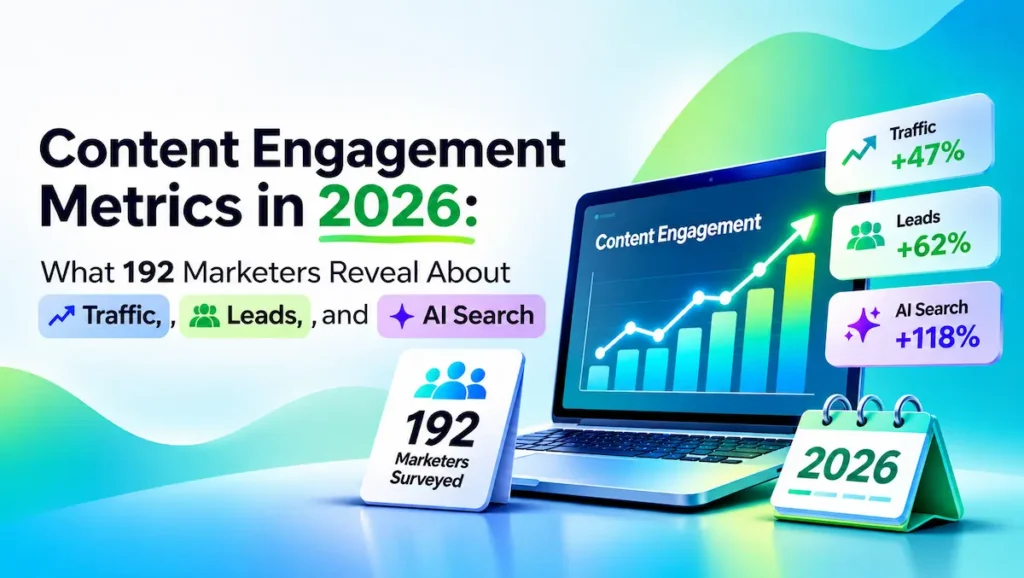
Many marketers expected 2026 to be a difficult year for content. AI Overviews, zero-click answers, and chatbot search were supposed to reduce clicks, lower engagement, and cut the leads that come from content.
New research suggests that didn’t happen.
Naxisweb is proud to be an Official Research Partner for the GoodFirms study Content Engagement Metrics 2026: What 192 Marketers Reveal. The study surveyed professionals who plan, create, and measure content. In this post, we break down the key findings and what they mean for your content strategy.
Content Performance Held Up in 2026
The GoodFirms research is based on 192 survey responses from professionals working in content strategy, marketing, content creation, and performance measurement. Despite the fear around AI search, the results were mostly positive:
- 66.3% reported growth in organic website traffic, with 38% reporting a significant increase and 28.3% reporting some increase.
- 63% reported growth in overall content engagement.
- 60.9% reported growth in content-driven leads or conversions.
Our takeaway: Good content still works. The difference in 2026 is how it gets discovered and how its success is measured.
What “Meaningful Engagement” Means Now
Engagement no longer means a page view. 60.9% of marketers said meaningful content engagement means moving audiences toward action, and 63% said they measure engagement to improve lead generation and nurturing.
The study explains that engagement can include website visits, reading time, clicks, shares, comments, subscriptions, return visits, leads, conversions, and purchases. These signals do not carry equal weight.
The Metrics Marketers Track Most
According to the research, the most commonly tracked content engagement metrics are website traffic or pageviews (81.5%), clicks or CTR (65.2%), form submissions or leads (58.7%), and engaged time (56.5%).
The more interesting result is that what marketers track most often is not necessarily what they consider most conclusive. Traffic is easy to measure, but leads and revenue are what decision makers care about.
Here is how we group these metrics for clients:
| Level | What It Shows | Example Metrics |
|---|---|---|
| Reach | Is the content being found? | Pageviews, impressions, AI citations |
| Attention | Is the content being consumed? | Engaged time, scroll depth, return visits |
| Action | Is the content driving business? | Form fills, calls, conversions, revenue |
The Attribution Gap Is the Biggest Problem
One of the most important findings is that only 26.1% of marketers connect content engagement to business outcomes very effectively across most content and channels.
The report describes this as an attribution gap. Marketers increasingly want to judge content by commercial outcomes, but most still struggle to connect engagement signals to eventual business results.
To close the gap:
- Set up conversion tracking for every content goal. That includes forms, calls, chat starts, and downloads, not only “contact us” clicks.
- Use UTM parameters consistently across email, social, and partner placements.
- Map content to the funnel. Top-of-funnel blogs should be judged on assisted conversions, not last-click sales.
- Review CRM data with content data. Ask new leads which article or answer brought them in.
Attribution works best when it is built into your organic search strategy from the start, not added after content is published.
AI Search Is Now a Distribution Channel
AI search is no longer only a threat to traffic. 65.2% of marketers say AI search is emerging as a new content discovery and distribution channel.
This matches what we see in Generative Engine Optimization (GEO) and Answer Engine Optimization (AEO) work. Related GoodFirms research on SEO in 2026 found that 43% of marketers are actively implementing GEO strategies, up from near zero in 2025. Yet a separate GoodFirms release reported that only 14% of marketers track AI search citations, even though 89% of brands already appear in them.
To make content more likely to be cited by ChatGPT, Gemini, Perplexity, and Google AI Overviews:
- Answer the question in the first two sentences of each section.
- Use original data and named sources. LLMs favor content with clear, verifiable facts.
- Add FAQ sections and schema markup so answer engines can extract clean responses.
- Build brand mentions on authoritative sites, including research partnerships like this one and earned media through HARO link building.
- Track AI citations and share of voice with tools such as Ahrefs Brand Radar.
Repurposing Content Pays Off
Teams that reuse their best content see better lead results. 71.7% of routine repurposers report lead growth, compared with 51% of occasional or rare repurposers.
A strong blog post can become a LinkedIn carousel, a short video, an email series, a podcast segment, and an FAQ page. Each format reaches a different audience and gives AI engines more sources to cite.
How naxisweb Applies These Findings
At naxisweb, we use this research to guide how we build and measure content for clients:
- Measure beyond traffic: Our SEO services include dashboards that connect content to leads and revenue.
- Optimize for AI search: We structure content for GEO and AEO and track LLM citations.
- Build authority: Our authority-building backlink campaigns earn contextual, do-follow links and brand mentions that support both rankings and AI visibility.
- Repurpose systematically: We turn top-performing content into multi-channel assets.
Frequently Asked Questions
What are content engagement metrics?
Content engagement metrics measure how people interact with your content. They include pageviews, time on page, clicks, shares, return visits, form submissions, and conversions.
Which content engagement metric matters most in 2026?
Traffic is the most tracked metric, but leads and conversions are the most meaningful. The best metric is the one that shows content moving people toward a business action.
Is AI search hurting content engagement?
According to the GoodFirms 2026 research, most marketers saw growth in traffic, engagement, and leads, and many now see AI search as a new discovery channel.
How do I connect content engagement to revenue?
Use conversion tracking, consistent UTM tagging, CRM integration, and multi-touch attribution so you can see which content contributes to leads and sales.
How can I get my content cited by AI tools?
Write clear, direct answers, include original data, use FAQ and schema markup, and build mentions on authoritative websites.
Conclusion
The 2026 data shows that content is still delivering traffic, engagement, and leads. The challenge has moved from producing content to measuring its real business impact and making it visible in AI search.
Want to know which of your content drives revenue? Contact naxisweb for a content performance and AI visibility audit.
